

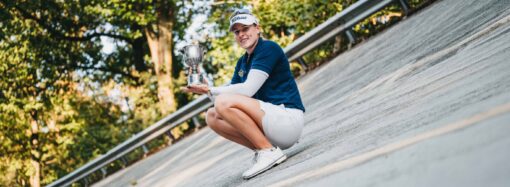


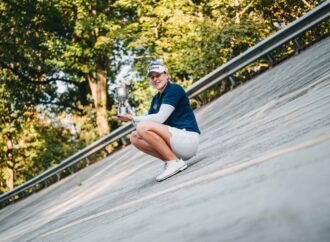
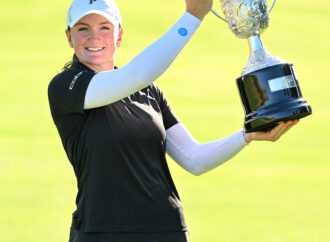
Born in the Basque Country and now based in Castellón, Amaia Latorre is a talented golfer who moves forward with a steady and silent determination. A lover of music and teamwork, she is one of those players who collect victories without making noise — in true Scandinavian style, one might say. Strong-willed and highly disciplined,
Born in the Basque Country and now based in Castellón, Amaia Latorre is a talented golfer who moves forward with a steady and silent determination. A lover of music and teamwork, she is one of those players who collect victories without making noise — in true Scandinavian style, one might say.
Strong-willed and highly disciplined, Amaia has steadily climbed the ranks in a sport she never expected to become her path, but which ultimately captivated her. Golf demanded a sacrifice: leaving behind an easier route, albeit a shorter one, to pursue a more demanding and ambitious journey.
She turned professional in 2022, and since then has already tasted victory. This season, she has taken another step forward, competing at a higher level and measuring herself against more experienced players as she continues to grow and consolidate her game.
What is her greatest secret? Never expecting anything.
That philosophy, combined with her consistency and calm approach, defines a golfer who is serious, disciplined, gracious, and grateful — an authentic Amaia who has won us over both on and off the course.
How was the experience of sharing the field with top players at the Andalucía Costa del Sol Open de España?
For me, it was a gift. Receiving an invitation from the Spanish Golf Federation is already a gift in itself, and on top of that, being able to play with players like Azahara Muñoz… I told my parents: “This is a week to enjoy, and if I can also enjoy it playing with someone who competes on the LPGA, that would be incredible.”
How was your first experience playing a LET event?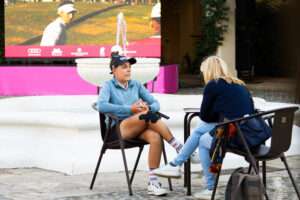
At my first LET tournament I was lucky enough to travel with my parents and experience it as a team, which made it very special. It was obviously quite stressful. I’ve gained a lot of experience on the LETAS, where you tend to look further ahead and the cut becomes less central. Coming back to the LET and having to think about making the cut again was a bit of a shock. I had to adapt, and mentally it was very difficult to bring out my best level. I played well in Amsterdam and Evian, but after that I played many tournaments without really finding my game.
I’ve heard La Sella is your favourite tournament.
It’s a fantastic event. We’re treated very well, the food is great, and the prize money is significant. It’s definitely a tournament I have marked in red on my calendar.
And Tenerife as well, right?
Yes, that’s another one. I went there on holiday last year and fell in love with the place — I even have it tattooed. Thinking that I could play there, especially around my birthday, felt like the best gift. Having that opportunity was incredible.
You came to golf almost by chance from football. How did that happen?
I started putting at the age of three, when I was first let loose on the putting green. My parents have decent handicaps, and I’ve always competed at my club. For years I combined golf and football, fifty-fifty. They are completely different sports, but when I realised that football has an age limit while golf doesn’t, things naturally went in that direction.
What position did you play in football?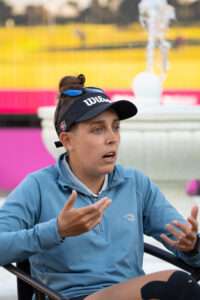
I was a utility player — whatever the team needed. I wore number eleven. I liked playing as a defensive midfielder or centre-back, but I also played left-back and winger.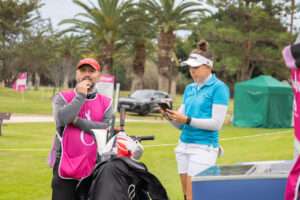
In golf, would you describe yourself as conservative or aggressive?
As an amateur, I was very conservative. Now I’ve learned when to be conservative and when not to be. For example, at Guadalhorce, on the 12th hole — which is quite demanding — depending on the pin position, I would lay up and try to make three. It depends on the day, the feeling, and the circumstances, so I wouldn’t define myself one way or the other.
Football is a team sport and golf is very individual. How do you handle that?
Golf is a bit of both. You have to be sportsmanlike. When you play against someone you like and she wins, you’re genuinely happy for her. If the person who beats you isn’t someone you connect with, the loss feels harder. Golf isn’t a team sport, but what I learned from football has helped me be more sportsmanlike and see things differently off the course.
You often have your family on the bag. What is that like?
I usually don’t have a professional caddie. My mother is normally on the bag, although at Guadalhorce my father stepped in. It’s very comfortable — they manage me really well, and I let myself be managed. We communicate a lot during tournaments; I even send them podcasts after events.
Are your parents demanding when it comes to results?
I’ve been very lucky with them. The upbringing they gave my sister and me was excellent. They would drop me at the golf course and say, “We’ll pick you up at this time,” and they were never overbearing, unlike what I’ve seen with other young players. They understood my character and allowed me to make my own mistakes, guiding me along the way. Today, I’m very grateful for that, because the way I manage my rounds comes largely from them.
Are you happy you chose golf?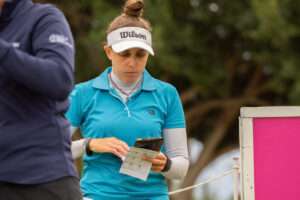
Very much so. When I turned professional, I was really afraid of whether I’d be able to train for so many hours, but I adapted using my own tools and I don’t regret it at all. I start from zero — nobody expects anything from me, and everything is a surprise. That’s how I approach my career.
This year you’ve been a rookie. Did you know how to handle life on the LET?
I’ve learned a lot from players I’ve been around, like Nuri, with whom I’ve caddied a couple of times on the LET. On the LETAS, we’re all new and the atmosphere is very friendly — everyone is friends. On the LET, you feel the competition more; players tend to stay within their own bubble. It’s also harder to talk on the course because everyone has a caddie. That said, once they play with me and get to know me, it becomes much easier to connect.
Your image is closely linked to wearing headphones and music.
Absolutely. When people talk about the music at LIV Golf, I always say, “I wish!” Sometimes humming a song or having one in my head really helps me. It gives me rhythm, and because I always train with noise, things like planes, trains, or shared greens don’t bother me at all.
What kind of music do you listen to?
It’s very mood-dependent. I have a pre-round playlist that’s more focused and a bit darker — I listen to a lot of rap — to get fired up. Other times I’m more happy flower, listening to melodic, sing-along songs.
Did that love for music come from your parents?
I think so. When we were kids, my parents used to play songs that I still listen to today and know by heart. Music is a way for me to express myself, to let out what I carry inside.
The toughest topic: sponsors. How are things going?
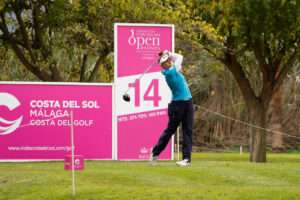 It’s a difficult issue. Everyone will tell you they never have enough sponsors and that this life is very expensive. I manage my own emails and I know how hard it is — personally, I find it very difficult to “sell myself.” I do have some sponsors, and we’re adding them gradually, but in Spain it’s really hard to secure sponsorships.
How do you see next season?
I try to keep expectations low. I really wouldn’t like to be stuck between the two tours, LET and LETAS. I have full status on the LETAS, and I’m going to LET Q-School aiming for a top-20 finish, but I almost prefer not to be in-between. My focus is on earning that card, although this is golf. I see myself playing on the LETAS and the Santander events I’m able to enter.
Do you believe in luck?
In golf, you have to believe in luck.
We wish you all the luck in the world, Amaia, to finish inside the TOP 20 and earn your full LET card. And if not this year, there will always be another chance.





Leave a Comment
Your email address will not be published. Required fields are marked with *