





By: Chicho Morales, Par4 Media The history of Spanish golf started in the year 1891 on the so-called “Isla Redonda”. Specifically on the 17th of December 1891. The British colony residing on the island founded Las Palmas Golf Club, which is officially considered the oldest golf club in Spain. Back in the day the club
By: Chicho Morales, Par4 Media
The history of Spanish golf started in the year 1891 on the so-called “Isla Redonda”. Specifically on the 17th of December 1891. The British colony residing on the island founded Las Palmas Golf Club, which is officially considered the oldest golf club in Spain. Back in the day the club was located on the upper part of the city of Las Palmas, in the “Lomo del Polvo” and then it was moved to “Los Llanos de Bandama” in the year 1957, where it still resides to this day.
Gran Canaria is one of the most important golf destinations in all of Spain and Europe. The entire archipelago is under the influence of the Trade Winds, that blow with less strength during the winter and they are more constant during the summer. This has led the island of Gran Canaria to be known as the small continent, as it can be cold and rainy in the central and northern parts of the island, while in the south the weather is warmer. The temperature differences can even be from 14° in the center, to 24° in the south, two areas separated by a distance you can cover in 30 minutes by car. This allows you to play golf with mild temperatures during the entire year. Between San Agustín and Mogán lies the most important touristic zone of the island, with hotels of 3, 4 and 5 stars. The town of San Bartolomé de Tirajana holds 70% of all the available hotel rooms of the island. With Mogán being the next tourist hotspot with almost 23%.
The most iconic beaches on the island are located in the south area, like “La Playa del Inglés” and Maspalomas, with the Dunes of Maspalomas separating the two beaches.
Las Palmas
The first place you have to visit on the island is the city of Las Palmas de Gran Canaria, founded on the 24th of June 1478. It is the largest city of all the islands as well as the place with the greatest cultural diversity. The city has two touristic spots that are very important. The old town that goes from San Telmo park until the Cathedral area. We are talking about Vegueta, a place where you can find old houses and churches that stand out because of their architectural mix between Europe and America. The harbor holds one of the best capital city beaches in the world, the Playa de Las Canteras. There you can find the Santa Catalina park, where every year the carnival of the city takes place.
Apart from the beach, Gran Canaria offers other attractions. In the central area it is possible to appreciate the symbol of the island, the Roque Nublo, which has amazing views of El Teide and the island of Tenerife. The volcanic mountains offer a great variety of routes for hikers. Another must is the visit to the town of Teror, where the Basílica of the Virgen del Pino is located, which is the patron saint of the island of Gran Canaria.
The gastronomy of the island stands out because of its great variety. It is recommended to taste the sancocho canario with potatoes in a style known as “arrugadas” and the gofio escaldado in the north region, specifically in Agaete. It is also mandatory to try the cheese known as Flor de Guía.
Golf
Gran Canaria at the moment has 6 active courses. There is only one which is closed, The Cortijo Club de Campo.
The Real Club de Golf of Las Palmas was founded in December of 1891 by the members of the many British families residing in Gran Canaria. It is, because of its foundation date, the oldest golf course in Spain and also one of the oldest in Europe. The creation of Las Palmas Golf Club, as it was originally named, was due to two fundamental factors: the desire of the British citizens living in Gran Canaria since the XIX century to have a place where they could play their favorite sport; and the other, the decision of the British investors in the developing sector of tourism to offer a complementary attractive, as it was and still is, golf. In 1955, the course was moved to the Llanos de Bandama, where it still resides today; it was designed by the Scottish Mackenzie Rosas.
The club is now located close to the Caldera of Bandama. It is a par 71, with 18 holes, where it should be noted that 9 of the holes have tees with out of bounds. The holes to be careful with are the 10th and the 11th as they can spell disaster for a player having a good round. The hole 10 is a par 3 with out of bounds to the right and usually with cross winds from right to left, hole 11 is another one with out of bounds on the right. The club has a small hotel with 33 rooms overlooking the course and the peak of Bandama. It is also equipped with two tennis courts, an equestrian area and a swimming pool.
Las Palmeras Golf is the first urban golf course in the Canary islands. Composed of 18 holes par 3, and valued by the Real Federación Española de Golf , as a Pitch & Putt, with holes having a distance between 40 and 120 meters, allowing golfers to practice their favorite sport without leaving the city.
It is noticeable that all the holes have two tees, with some of them making the first shot more difficult. There is a difference between the first 9 holes which have a purely British style and are used by the Golf School, and the second 9 holes that have a design similar to the American courses, where hole 15 stands out with the emblematic green being designed as an island. The so-called “Amen Corner” of the course is between the 14th and the 18th hole. This is because it is the most difficult part of the course and it can ruin any score, due to the presence of water obstacles plus this is the part of the course which is more exposed to the winds from the north.
Maspalomas Golf opened in 1968 and  it was the first touristic course in Spain. It is flat and has a great length, with wide and long fairways. Because it is close to the sea it is under the influence of the trade winds, producing a refreshing gentle breeze. All of this makes playing this course an enjoyable experience, even during the hottest summer days. Maspalomas Golf design was created by Mackenzie Ross, who also designed the current course of Real Club de Golf de Las Palmas. The course has hosted events at international level and it has 18 holes par 73.
Anfi Tauro Golf is a competitive course of 18 holes. Designed by prestigious and recognised designers Von Hagge, Smelek and Bari, renowned for their  innovative and challenging styles. They were responsible for the design of this course in an Arizona style. Having a lot of tees, it provides a more dynamic style, offering players of all levels a challenging and entertaining game. Anfí Tauro Golf also has nine par 3 holes. The course is surrounded by a large garden and impressive lakes.
Salobre Golf has an Old Course, inaugurated in 1999 and designed by Roland Favré. It has 18 holes par 71 and it has been the venue for important tournaments such as the Spanish PGA in 2006 and the Senior and Ladies Championships in 2001. The Old Course is one of the oldest courses on the island and it is ideal for players of all levels. It is characterized by tees at different heights, generous fairways and small greens. The most demanding holes are par 3, in particular the 11th, which is the emblematic hole 
 of the course because of its difficulty and the stone environment that surrounds its green. The Old Course has always stood out because of its capacity to adapt to the environment, mixing stone and wood to create a unique and sustainable course. There is also a New Course or North Course. This unique course was designed by Ron Kirby to blend in with the volcanic rock environment and provide a new challenge. As of September, nine new holes will be opened and the course will have 27 holes divided in three different courses.
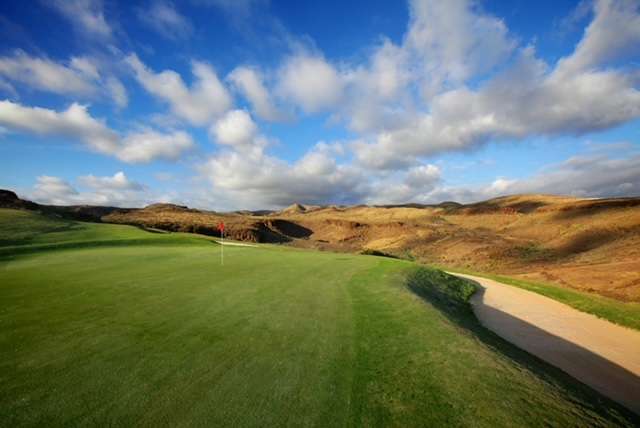
Lopesan Meloneras Golf is a design of Ron Kirby.  It was the sixth golf course to open in Gran Canaria, and the first for the Lopesan Hotel Group. In this course the PGA Spanish Championship was celebrated in the year 2007, with great success and the participation of elite professionals such as Rafa Cabrera and Álvaro Quirós, who were able to verify its natural beauty and challenging design.
In the second nine holes, from the 12th to the 16th, the course has magnificent views of the sea. Last year a venue of the European Tour took place in this course.










Leave a Comment
Your email address will not be published. Required fields are marked with *